Monday, 28 March 2011
Thursday, 24 March 2011
Task Six: Theory into Practice
Look at the CTS blog that Garry Barker has been writing to complement the lecture programme this year. Write a short response to one of the posts on the blog. Use the ideas that Garry is discussing to mount a short critical evaluation of one piece of Graphic design that you have produced on Level 5.
For the purpose of this task I have chosen to analyse my design for print module in which I designed a piece of packaging aimed at children, intending to promote the traditions of the Mexican holiday known as 'Dia de los Muertos'. Below is an image of one of my presentation boards that displays the key aesthetics of the design.
I have chosen to analyse this piece of work in direct relation to Garry's post about about surveillance, Foucault and how all graphic design is centre around communication. In the text Garry suggests that Michael Barnards theories of graphic design helping in the formation of social and cultural identities is not only common, but most designers are guilty of using stereotypical designs at least once within their career. It turns out I am guilty of this before my career even gets started.
In this particular case I have altered typefaces and colour choices in order to appeal to my desired target audience. The package is ideally marketed at 5-10 year olds and their parents, so in order to satisfy both these age groups I combined bright, bold colours and minimal type, but quite a complex design that hopefully can be appreciated by both young and old. In keeping with the aesthetics of traditional Mexican design I used geometric shapes and a repeated pattern around the exterior of the package. I took inspiration from the paper art known as 'papel picado', in which incredibly complex banners and various other paper decorations are crafted through a single sheet of sugar paper and someone who is skilled with a craft knife. This, initially, would not be clear to a child as traditional Mexican visuals are not as engrained as other cultures, such as Chinese or Greek as Garry mentions in his post, however the intention of the package was to educate and inform.
The purpose of the package is to get kids into the kitchen, baking traditional sugar cookies in the shapes of skulls. Why skulls? Well the holiday known as the 'Day of the Dead' is a celebration of lost loved ones, when families from all over the country spend the night in graveyards trying to tempt back the souls of departed friends and family members. It takes place on November 2nd and therefore has strong connotations with halloween, an insult rather than a complement. Nevertheless I took the traditional visual known as a 'sugar skull' and turned my whole package into a celebration of its design, with bright colours and flower motifs.
Task Five: Sustainability & Capitalism
Read the text- Balser, E (2008) 'Capital Accumulation, Sustainability & Hamilton Ontario'. We have copies in the CTS office, 115.
Write a 500 word critical summary of the text which explicitly adresses the following questions
How is sustainability defined in the text?
What are the main characteristics or tendencies of Capitalism
Define a 'crisis of Capitalism'. Offer an example.
What solutions have been offered to the sustainability question? Are these successful or realistic? - If not why are they flawed?
Is the concept of sustainability compatible with Capitalism?
Sustainability is defined as inter and intra generational equity in the social, environmental, economic, moral and political spheres of society by Donella Meadows within Erin Balser's text. However another definition, given by Brundtland, is that sustainability is 'the development that meets the needs of the present without compromising the ability of future generations to meet their own needs.' When discussing the former definition, sustainability is ideologically a communal concept, but realistically within capitalist societies it often falls to the individual and through technology. When discussing the latter definition sustainability has become a 'buzzword', a movement that everyone wants to be a part of.
Capitalism thrives on creating, then subsuming the other and continuously expands and traps things within its diverse web. It requires money for sustainability and constantly looks for new things to commodify and profit from. It is not a simplistic linear system but instead a complex one that subsumes not-capital markets and intensifies internal markets.
Crisis of capitalism is a passage of phases, from initial material expansion to a second phase of financial expansion, with each individual passage seemingly reaching its limit. However capitalism overcomes the crisis every time in an environment of constant new technologies, policies and ideas, which allow for crisis deferral. In other words capitalism survives by reinventing itself and actually benefits from the crises as they help continue the cycle of capitalisation, an example of this being the environmental crisis and global warming issues.
One solution offered to the sustainability question is the bio-diesel fuel plant (BIOX) discussed at great length in the text. Although it represented the ecological integrity and economic prosperity that is deemed so important for sustainability, it was at a disadvantage to the community around it. Whilst the idea seemed to be well considered and had promise it actually did more damage than good and posed serious health risks to the residents of Hamilton, Ontario.
Not only is the concept of sustainability compatible with capitalism, but both Paul Hawken and Al Gore suggest that the current practices of a capitalist society are the solution to the sustainability crisis. Hawken notes in his book 'The Ecology of Commerce: A Declaration of Sustainability and Natural Capital' that we have to work with who we are, which includes our strong instinct to shop the market, suggesting that capitalism is engrained within our lifestyles and changing it to fix the sustainability crisis would be near impossible. In the 2006 film 'An Inconvenient Truth' Al Gores further enforces this idea by seeking answers to sustainability through technology, democracy and of course capitalism.
Write a 500 word critical summary of the text which explicitly adresses the following questions
How is sustainability defined in the text?
What are the main characteristics or tendencies of Capitalism
Define a 'crisis of Capitalism'. Offer an example.
What solutions have been offered to the sustainability question? Are these successful or realistic? - If not why are they flawed?
Is the concept of sustainability compatible with Capitalism?
Sustainability is defined as inter and intra generational equity in the social, environmental, economic, moral and political spheres of society by Donella Meadows within Erin Balser's text. However another definition, given by Brundtland, is that sustainability is 'the development that meets the needs of the present without compromising the ability of future generations to meet their own needs.' When discussing the former definition, sustainability is ideologically a communal concept, but realistically within capitalist societies it often falls to the individual and through technology. When discussing the latter definition sustainability has become a 'buzzword', a movement that everyone wants to be a part of.
Capitalism thrives on creating, then subsuming the other and continuously expands and traps things within its diverse web. It requires money for sustainability and constantly looks for new things to commodify and profit from. It is not a simplistic linear system but instead a complex one that subsumes not-capital markets and intensifies internal markets.
Crisis of capitalism is a passage of phases, from initial material expansion to a second phase of financial expansion, with each individual passage seemingly reaching its limit. However capitalism overcomes the crisis every time in an environment of constant new technologies, policies and ideas, which allow for crisis deferral. In other words capitalism survives by reinventing itself and actually benefits from the crises as they help continue the cycle of capitalisation, an example of this being the environmental crisis and global warming issues.
One solution offered to the sustainability question is the bio-diesel fuel plant (BIOX) discussed at great length in the text. Although it represented the ecological integrity and economic prosperity that is deemed so important for sustainability, it was at a disadvantage to the community around it. Whilst the idea seemed to be well considered and had promise it actually did more damage than good and posed serious health risks to the residents of Hamilton, Ontario.
Not only is the concept of sustainability compatible with capitalism, but both Paul Hawken and Al Gore suggest that the current practices of a capitalist society are the solution to the sustainability crisis. Hawken notes in his book 'The Ecology of Commerce: A Declaration of Sustainability and Natural Capital' that we have to work with who we are, which includes our strong instinct to shop the market, suggesting that capitalism is engrained within our lifestyles and changing it to fix the sustainability crisis would be near impossible. In the 2006 film 'An Inconvenient Truth' Al Gores further enforces this idea by seeking answers to sustainability through technology, democracy and of course capitalism.
Task Four: Communication Theory
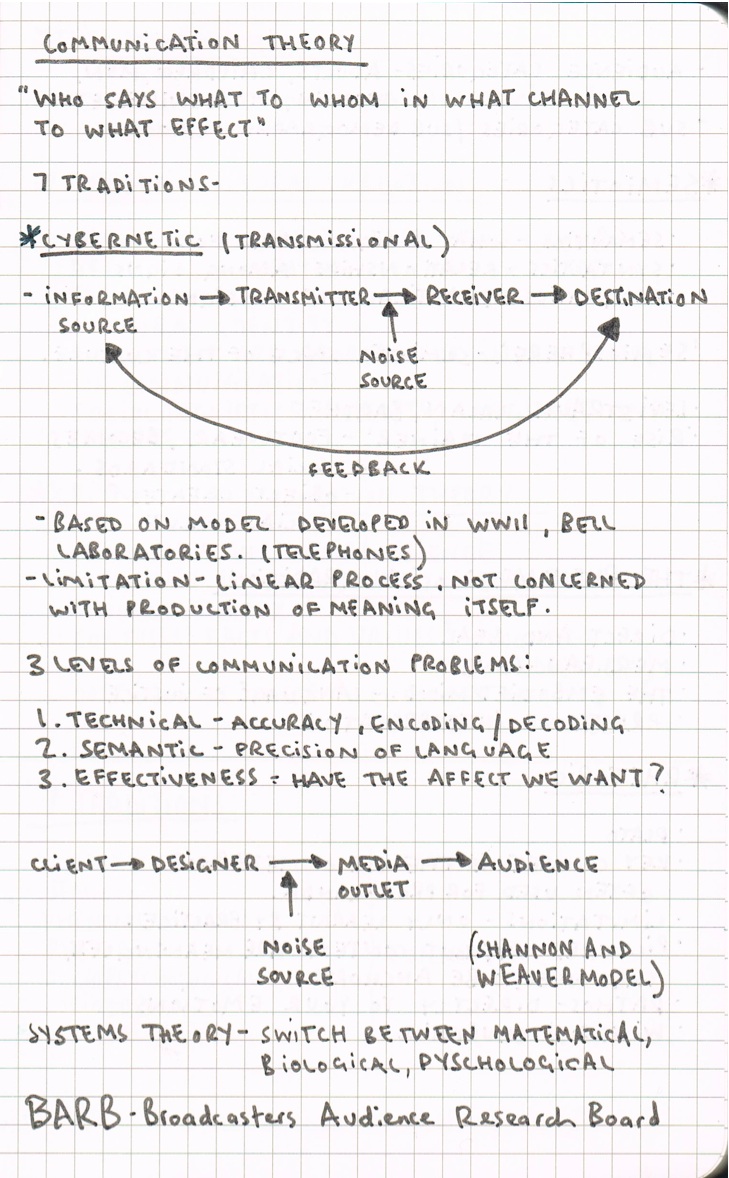
Use Shannon & Weaver's model of the communication process to write a 300-400 word analysis of a work of Graphic Design. Comment on the ways in which the piece of Graphic Design attempts to communicate to a specific audience, using techniques of redundancy, entropy or noise.
Look at Fiske, J. (2002) 'An Introduction To Communication Studies' if you are struggling.
I have chosen to look at the above piece of design and analyse it using Shannon and Weavers communication model. In this particular example the information source can be considered as the client who asked for an advertisement to be created in order to promote the empty space for promotion. The next step is to determine who is 'transmitting the message' and in the case of the above example it would be the designer who has combined type and image to visually communicate their intended message. The 'channel' or 'media outlet' is the billboard itself and its positioning. The design itself is very clever and I feel is quite entropic. When a billboard is empty most of the time it would just be blank, perhaps there would be some simple text in the middle, but certainly nothing as complex as this. At first glance you would assume its an advert for a new TV programme, perhaps even a night club or perfume, due to Paris Hiltons synonymy with partying and the Hollywood lifestyle. However it is only on second glance that you notice the word 'vacant' and the phone number on the right hand side, combine it with the knowledge that Miss Hilton is not the brightest and you truly understand the meaning of the billboard. The text could be considered quite redundant as it clearly communicates the purpose of the advert and if it where to be displayed purely on its own then I doubt there would be any confusion. The image is the component that takes slightly longer to process, but once you do succeed in processing you are bound to feel a little smug at the fact that not only do you understand the insult, but appreciate its humour also. Finally the 'destination' or 'audience' is anyone who notices the advert and receives the intended message, with hopefully someone taking an interest in buying up the promotional space.
Despite the fact that on the Shannon and Weaver model 'noise source' is shown pointing at the central linear component; 'channel', there is the potential for possible noise at any stage. For example the 'transmitter' or designer in our case could have gotten the composition completely wrong or made the text too small, or the image too big for that matter. A different colour could have been chosen for the word 'vacant' that made it blend into the image more and not stand out, therefore losing the message of the billboard altogether. There is also the threat of other billboards imposing on this one, and with so much information on display the meaning of all gets lost. Additionally as the image above actually displays the positioning of the billboard is obviously on a main road somewhere. Depending on the speed limit of this road or how busy it gets with the possibility of traffic jams, the amount of information taken in by the audience may not be sufficient enough. However out of all these generic problems, there is one more complex and specific to this billboard that stands out the most. What if you don't know who Paris Hilton is? After all the reason why I understand the joke it because I am of a generation that is used to seeing this woman's face plastered on every gossip magazine, but a slightly older generation might not be. It's almost as if it's a private joke between the designer and the intended audience, with the ability to exclude anyone who might not understand it. Another noise source is the fact that Miss Hilton actually made a formal complaint over the use of her image and demanded it be removed immediately. Surely if this were the case then the billboard would still function as the text is redundant enough, but it certainly wouldn't be as entertaining.
Monday, 17 January 2011
Essay Proposal
For my essay question I want to deal with the ideologies I learnt about in the psychoanalytical gaze lecture. I hope to deal more specifically with film posters created purposely for feminist or all female cast movies. I hope to compare examples of these with compositions that were created to promote male orientated films and perhaps even those aimed at a misogynistic mind set. My intentions are to highlight the differences and the reason why the differences are so vital for subconsciously drawing in the right audience. Key areas I will discuss are: scopophilia, suture, intra and extra digetic gazes and more obviously feminist psychoanalysis.
I hope to concentrate largely on the films of Pedro Almodovar, a Spanish director who is well known for creating feature films with strong female leads and ensemble casts. The poster to the left is a prime example of what I want to discuss and compare to posters such as this and this. The stark difference in design is instantly obvious and therefore each film has an intended audience before the film has even begun. Thats why promotional posters are so important, they have to draw in the right people and if they don't communicate the right message then a large number of the audience would walk out in the middle of the film.
Initial bibliography:
'If there is any structural principle governing the organisation of feminist documentary film, it is that provided by autobiographical discourse: 'film after film shows a woman, telling her story to the camera'. '
Womens Pictures; Feminism and Cinema, 1982, A. Kuhn, pg. 148
'It has somehow escaped theoretical attention that sexual difference is the effect of dominant cinema's sound regime as well as its visual regime, and that the female voice is as relentlessly held to normative representations and functions as is the female body.'
The Acoustic Mirror; The Female Voice in Psychoanalysis and Cinema, 1988, K. Silverman, preface
'Advertising in this society builds precisely on the creation of an anxiety to the effect that, unless we measure up, we will not be loved. Every minute region of the body is now exposed to this kind of scrutiny of the ideal.'
The Look, Rosalind Crawford in Reading Images, J. Thomas, 2000, pg. 38
I hope to concentrate largely on the films of Pedro Almodovar, a Spanish director who is well known for creating feature films with strong female leads and ensemble casts. The poster to the left is a prime example of what I want to discuss and compare to posters such as this and this. The stark difference in design is instantly obvious and therefore each film has an intended audience before the film has even begun. Thats why promotional posters are so important, they have to draw in the right people and if they don't communicate the right message then a large number of the audience would walk out in the middle of the film.
Initial bibliography:
'If there is any structural principle governing the organisation of feminist documentary film, it is that provided by autobiographical discourse: 'film after film shows a woman, telling her story to the camera'. '
Womens Pictures; Feminism and Cinema, 1982, A. Kuhn, pg. 148
'It has somehow escaped theoretical attention that sexual difference is the effect of dominant cinema's sound regime as well as its visual regime, and that the female voice is as relentlessly held to normative representations and functions as is the female body.'
The Acoustic Mirror; The Female Voice in Psychoanalysis and Cinema, 1988, K. Silverman, preface
'Advertising in this society builds precisely on the creation of an anxiety to the effect that, unless we measure up, we will not be loved. Every minute region of the body is now exposed to this kind of scrutiny of the ideal.'
The Look, Rosalind Crawford in Reading Images, J. Thomas, 2000, pg. 38
Sunday, 12 December 2010
Task Two
Despite Adorno writing his essay on popular music in 1941 before most of the 'pop music' we listen to these days was even imagined, his points remain incredibly relevant and poignant to this day. Straight away he assigns music into one of the two categories; popular or serious. Adorno much prefers these categories and feels the alternative 'lowbrow or highbrow' is not precise enough. He immediately praises the efforts of Beethoven and claims his Appassionata 'achieves the utmost dramatic momentum by omitting the exposition and starting with repetition'. However these principles could never be applied to popular music as the listener has already automised the 'framework' for themselves.
Adorno goes as far to suggest that by subjecting ourselves to purely 'standardised' music we enter into a 'system of response mechanisms wholly antagonistic to the ideal of individuality in a free, liberal society'. Here he also reinforces the idea that even though many would argue individulity can be achieved through the masses of different genres available, he suggests that popular music is simply a 'multiple choice questionnaire'. Adorno entitles this 'pseudo-individualisation' and states that although we think we have free reign over what we choose to listen to it is pre-determined in production and later in marketing and advertising techniques. This is pinpointed in his essay by saying all popular music has a 'fundamental identity of the material' and 'great similarity of presentation apart from their emphasized distinguishing trademarks'.
My personal choice for a modern day example of what Adorno would call a 'freezing of standards' is a song taken from The Kooks 2006 album Inside In/Inside Out. I chose this because by 2006 the genre known as 'indie' had already been around for nigh on 10 years and it was beginning to sound a little stale. For example bands like Razorlight, The Arctic Monkeys, The Killers and The Libertines all appeared and became popular artists within the same few years, with all their material sounding very similar in my own personal opinion. What was worse was the image of the bands; it seemed as though any one with bed-head, skinny jeans and an ill fitting t-shirt/leather jacket combo had guaranteed record sales. I'm sure when indie artists were first starting to get recognised in the early 2000's, such as Modest Mouse, the music was fresh and at least trying to 'circumvent standardisation', however it was inevitable that eventually the composition would begin to 'hear for the listener' instead of vice versa.
Adorno goes as far to suggest that by subjecting ourselves to purely 'standardised' music we enter into a 'system of response mechanisms wholly antagonistic to the ideal of individuality in a free, liberal society'. Here he also reinforces the idea that even though many would argue individulity can be achieved through the masses of different genres available, he suggests that popular music is simply a 'multiple choice questionnaire'. Adorno entitles this 'pseudo-individualisation' and states that although we think we have free reign over what we choose to listen to it is pre-determined in production and later in marketing and advertising techniques. This is pinpointed in his essay by saying all popular music has a 'fundamental identity of the material' and 'great similarity of presentation apart from their emphasized distinguishing trademarks'.
My personal choice for a modern day example of what Adorno would call a 'freezing of standards' is a song taken from The Kooks 2006 album Inside In/Inside Out. I chose this because by 2006 the genre known as 'indie' had already been around for nigh on 10 years and it was beginning to sound a little stale. For example bands like Razorlight, The Arctic Monkeys, The Killers and The Libertines all appeared and became popular artists within the same few years, with all their material sounding very similar in my own personal opinion. What was worse was the image of the bands; it seemed as though any one with bed-head, skinny jeans and an ill fitting t-shirt/leather jacket combo had guaranteed record sales. I'm sure when indie artists were first starting to get recognised in the early 2000's, such as Modest Mouse, the music was fresh and at least trying to 'circumvent standardisation', however it was inevitable that eventually the composition would begin to 'hear for the listener' instead of vice versa.
Thursday, 9 December 2010
Sunday, 28 November 2010
Task One: Panopticism
The social network site ‘Facebook’ could be considered a modern mechanism of Panopticism. It is an online hub where people can post almost anything about themselves, or others for that matter. According to Foucault in the Panopticon ‘the inmate is seen but he does not see; he is the object of information, never a subject in communication.’ (Foucault, 1977, pg 65). Another aspect of Facebook panopticism is the constant updating of statuses, which users think are being viewed by everyone in their friend list, when perhaps not a single person has seen them. This can be better described by Foucault as the intention ‘to induce in the inmate a state of conscious and permanent visibility’ (Foucault, 1977, pg 65). Another way of phrasing this is the Facebook user ‘never knows weather he is being looked at, at any one moment, but he must be sure that he may always be so’ (Foucault, 1977, pg 65) and must therefore act accordingly.
When we ‘friend’ someone we make it ‘possible to see constantly and to recognize instantly’ (Foucault, 1977, pg 64). With this we also start to regulate each other and have the ability to report any content that we may feel is inappropriate, or as Foucault wrote ‘the panopticon may even provide an apparatus for supervising its own mechanisms’. (Foucault, 1977, pg 67).
Self-regulation is also a key Foucauldian theory present in the Facebook environment. Users are able to post any status they may wish, however most will choose selectively and only post things they feel will be appreciated or ‘liked’ by fellow users. With this they fall into the ‘docile bodies’ category becoming obedient and self-correcting.
[Foucault, M. 1977 'Discipline and Punish']
When we ‘friend’ someone we make it ‘possible to see constantly and to recognize instantly’ (Foucault, 1977, pg 64). With this we also start to regulate each other and have the ability to report any content that we may feel is inappropriate, or as Foucault wrote ‘the panopticon may even provide an apparatus for supervising its own mechanisms’. (Foucault, 1977, pg 67).
Self-regulation is also a key Foucauldian theory present in the Facebook environment. Users are able to post any status they may wish, however most will choose selectively and only post things they feel will be appreciated or ‘liked’ by fellow users. With this they fall into the ‘docile bodies’ category becoming obedient and self-correcting.
[Foucault, M. 1977 'Discipline and Punish']
Friday, 5 November 2010
Monday, 22 March 2010
Semiotics

Above is the original theatrical poster for the first ever ‘Star Wars’ instalment. It signifies a fantasy/ sci-fi film, one of the most celebrated sci-fi franchises of all time at that. The signifier is a hand rendered collage of all the main characters featured in the film, with the title ‘Star Wars’ placed just below and to the right. The signified is broken down into the denoted; the Luke Skywalker, Princess Leia and Han Solo characters battling the cloaked and shrouded mysterious character that is Darth Vader, and the connoted; the ever present struggle between good and evil forces whilst a rag-tag group of accomplices and sidekicks, who pose no actual reason to be there, stand by and idly watch whilst others fight battles for them.
Star Wars has become probably the biggest sci-fi / space franchise of all time, with competition at the time from the likes of Ridley Scott’s ‘Alien’ features, and more recently the child orientated ‘Harry Potter’ series. It was first released in 1977 and fast became a worldwide pop culture phenomenon. However this was not known at the time, therefore the utmost effort had to be put into the correct composition and portrayal of certain characters.
The poster promoting a film is always vital as it is the only opportunity to gain prospective viewers to buy into the premise that is being sold. It must be visually engaging and somehow communicate the complex plot within a single frame. This is probably why so many different aspects and scenarios are depicted within this example. Whereas in more recent years if I or anyone else were to see just a singular image of one of the aspects shown, varying from the entire character of C3PO to the most specific detail of Princess Leia’s hair style, we would know what is being communicated.
The most obvious subconscious message that is being connoted is the striking difference between the characters. For example the subtle way in which Luke and Leia are dressed all in white, a colour traditionally associated with all positive connotations such as purity and innocence. Whilst Darth Vader in the background is cloaked from head to toe in black, which is more often that not closely linked with death and all round negative connotations. It is also interesting to see how Han Solo, a character who was introduced as a ‘reckless mercenary’ only interested in serving himself, but turned out to be inherently good, is dressed in predominantly black with a strong white highlight. Other aspects that require analysis is the simplicity of the logo in the bottom right corner. It may seem like a simple sans serif design with stars in the background, but it actually connotes the now infamous ‘scrolling text’ beginning of the first feature film. This is communicated by distorting the simple two word phrase so that it is smaller at the top than the bottom.
As time has gone on and more Star Wars films were released and subsequently more posters put into production, many things featured have disappeared but also many denotations have remained. For example the star-lit sky background has featured in all posters, connoting the vast unexplored space in the universe and the mystery that surrounds it, to the constant inclusion of objects like ‘light-sabers’ and ‘spaceships.’ On the surface these may simply denote technology, but ultimately connote something much deeper like the gradual overpowering of the modern world and how machinery and things we can no longer control will take over all we know now.
Saturday, 6 March 2010
Modernism Harvard Referencing
1. ‘Virtually every history of modern art is dominated by the artistic production of the French capital, Paris. Hence, modern art is in a sense modern French Art’
Brettell, R.R. (1999) ‘Modern Art 1851-1928’, Oxford, Oxford University Press, pp3
2. ‘Modernism was a Western phenomena and, as we will see, traditionally located in two centres: Paris from the mid-nineteenth century to the mid-twentieth century and then, New York from the 1950’s onwards’
Meecham, P & Sheldon, J (2005) ‘Modern Art: A Critical Introduction’, 2nd ed. USA, Routledge. pp14-15
3. ‘Part of the problem with defining the 1930’s as a period of stasis or even reaction in French art is that it reflects and reinforces a teleological account of the history of twentieth-century art, in which New York inevitably emerges triumphant as the capital of modern art after 1945’
Barker, E (2004) ‘Varieties of Modernism: Edited by Paul Wood’, London, Yale University Press, pp11
4. ‘Modernism is modern art’s self-consciousness of itself as an autonomous practice’
Bernstein, J.M. (2006) ‘Against Voluptuous Bodies: Late Modernism and the Meaning of Painting’, California, Stanford University Press, pp3
5. ‘Robert Henri urged artists to engage with the vernacular modernity of urban life in the USA, and the term ‘urban vernacular’ may be a useful way of describing the genre dominant in the USA until the Second World War’
Harris, J. (1993) ‘Modernism in Dispute: Art Since the Forties’, Hong Kong, Yale University Press, pp20
Brettell, R.R. (1999) ‘Modern Art 1851-1928’, Oxford, Oxford University Press, pp3
2. ‘Modernism was a Western phenomena and, as we will see, traditionally located in two centres: Paris from the mid-nineteenth century to the mid-twentieth century and then, New York from the 1950’s onwards’
Meecham, P & Sheldon, J (2005) ‘Modern Art: A Critical Introduction’, 2nd ed. USA, Routledge. pp14-15
3. ‘Part of the problem with defining the 1930’s as a period of stasis or even reaction in French art is that it reflects and reinforces a teleological account of the history of twentieth-century art, in which New York inevitably emerges triumphant as the capital of modern art after 1945’
Barker, E (2004) ‘Varieties of Modernism: Edited by Paul Wood’, London, Yale University Press, pp11
4. ‘Modernism is modern art’s self-consciousness of itself as an autonomous practice’
Bernstein, J.M. (2006) ‘Against Voluptuous Bodies: Late Modernism and the Meaning of Painting’, California, Stanford University Press, pp3
5. ‘Robert Henri urged artists to engage with the vernacular modernity of urban life in the USA, and the term ‘urban vernacular’ may be a useful way of describing the genre dominant in the USA until the Second World War’
Harris, J. (1993) ‘Modernism in Dispute: Art Since the Forties’, Hong Kong, Yale University Press, pp20
Sunday, 24 January 2010
Monday, 30 November 2009
Paraphrasing
In the early twentieth century art was revolutionized and a new direction, one driven by 'self expression', was chosen. Art was now focused on the surroundings and different environments rather than the person or group of people featured in that environment, an approach that had never been seen or heard of before. Artists like Caillebotte and fellow French artists were leaders of this new style. As a result of this Paris remained pre-eminent in the movement, however other countries began to gradually embrace the new including Germany, Italy and Russia. Yet each country's interpretation remained strikingly different. This could possibly have been related to the three related moments in modernism. Modernization refers to machinery and technological advances, modernity is in reference to the individual experiences of the public during social change and lastly Modernism refers to the reflection of the new in its representation. With the influx of the modern, one half of society feared detachment from reality and artificial life replacing real life, whilst the other half where emphatic with exhilaration. Interestingly there was also a third point of view that relied more on understaning and knowledge of find the cause of modernization. In regards to the art world there where few artists who felt they needed to decode the modern world and change it in somehow. On the other side there were artists who wanted to sit back and where convinced art must transform itself. This difference in opinion remains prominent to this day especially in regards to the creation of ambitiuos art in the modern world.
Subscribe to:
Posts (Atom)